 SIGN-UP FOR THE MHPS NEWSLETTER!






It is easy to live with a cabinet door that is a little off until it starts catching your sleeve, bumping the next door, or refusing to sit flat. In an RV or manufactured home, cabinets get used all day, and the space around them is usually tight. When cabinet hinges are worn or mismatched, you feel it every time you reach for a mug or slide a pan back under the sink.
A good first step is just looking at what you already have. Once you know how the cabinet is built and how the door sits when it is closed, you are not guessing anymore. You can match the hinge to the job so it closes the way you expect and stays in line instead of drifting over time.
Know What You Have: Cabinet Build and Door Position
Face-Frame vs. Frameless Cabinets
Before you buy anything, take a minute to see what the hinge actually attaches to.
Face-frame cabinets have a frame around the front opening, like a picture frame. You can usually see and feel that raised edge. Many older manufactured homes use this style, and a lot of factory cabinetry does too. Frameless cabinets skip the front frame, so the door closes against a clean cabinet box edge and the hardware mounts inside the box.
Overlay vs. Inset Doors
Next, look at how the door sits when it is shut.
Overlay doors lay on top of the opening. They cover part of the frame or cabinet side. Inset doors sit inside the opening, creating a flush cabinet front. That difference matters because the hinge has to clear the frame and still let the door close all the way.
If you have overlay doors, measure the overlay before you order. Close the door, place a small piece of tape on the cabinet right at the door edge, then open the door and measure from the cabinet opening edge to the tape mark. For double doors, you can also measure both doors together, subtract the opening width, then divide by two to find the overlay per door.
With these measurements, it is much easier to find matching cabinet hinges, especially when you are replacing something that almost fits but never quite lines up.
Concealed Cabinet Hinges for RV and Mobile Home Cabinets
How to Identify Concealed Hinges
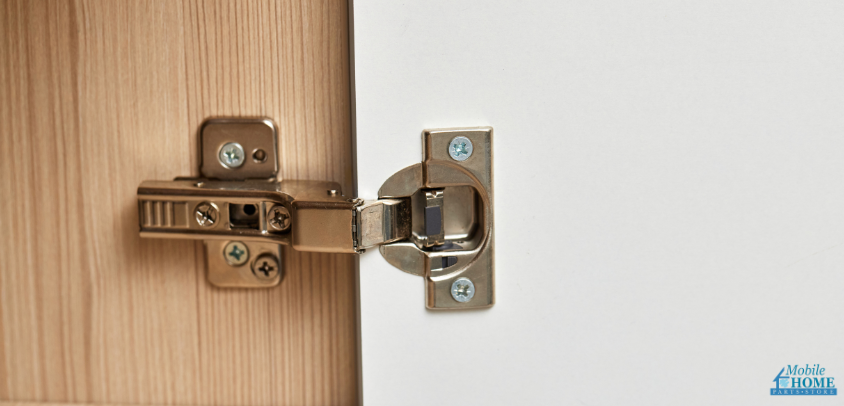
Open a cabinet door and look at the back. If you see a round recess cut into the wood with a metal cup inside it, you are probably looking at a concealed European-style hinge. When the door closes, you do not see any hardware from the front, only a clean cabinet face.
The cup sits in the door, and an arm reaches over to a mounting plate inside the cabinet. Many doors use the common 35 millimeter cup size, but it is still worth checking with a tape measure before you order replacements.
Most concealed hinges let you adjust the door side to side, in and out, and up or down. In a small kitchen or bathroom, those fine adjustments help a lot. Even a small change can stop a door from scraping the frame or bumping into the next door.
Overlay and Inset Options
You will also find different versions depending on how the door covers the cabinet.
Full overlay styles are shaped so the door covers most of the cabinet edge. Half overlay styles are used when two doors share a center partition, and the hinge geometry keeps the gap between doors even. Inset versions pull the door flush into the opening with a different arm shape or mounting plate.
If you want a calmer close, many concealed hinges come in soft-close or self-close versions. Soft-close slows the last part of the swing. Self-close uses spring tension to pull the door shut once it gets close to the frame. In a home that moves, both can help doors feel more secure and less likely to drift open.
Face-Frame Favorites That Keep a Traditional Look
Semi-Concealed Hinges
Face-frame cabinets often start with hinges you can see, at least a little. That is not a problem; it is simply a different way to hang the door.
Semi-concealed hinges attach to the face frame and hide part of the hinge behind the door. If you want to match your current hardware, take clear photos of the hinges from the front and inside the door to compare shapes and screw patterns. When the door is closed, you will usually see a small hinge knuckle on the frame. These are common on overlay doors and are easy to swap if you want to keep the same look in your kitchen or bathroom. These cabinet hinges are common on face-frame layouts in many RV and manufactured-home kitchens.
Wrap-Around Hinges
Wrap-around hinges are another useful option for face-frame cabinets, especially in retrofits. A partial wrap catches the frame on two sides. A full wrap hugs three sides. That bigger footprint can add support when a door has started to sag or when the old screw holes no longer feel solid.
Make sure the wrap will not hit a nearby partition or shelf edge inside the cabinet. A quick dry fit or careful measuring can help you avoid surprises later.
Traditional Cabinet Hinges That Keep It Simple
Butt Hinges
Sometimes you want a hinge that makes sense the moment you pick it up. Traditional styles do that. They are also easier to match visually if your cabinets already have visible hardware.
Butt hinges have two leaves joined by a pin. In cabinetry, they are often mortised into the door and frame so only the barrel shows when the door is closed. They work well for inset doors and for doors where you want a clean, classic edge. If the door is tall or heavy, adding a third hinge can help reduce sag over time.
Surface-Mount and Decorative Hinges
Surface-mount and decorative cabinet hinges screw right to the face of the door and cabinet. Butterfly styles fall into this group. They are fully visible, which can be part of the look or just a practical choice when you want to replace hardware without drilling cup holes or carving recesses. Since these hinges do not usually include soft-close, adding a catch or magnetic latch can help keep doors shut when you need a firmer close.
Flush, or no-mortise, hinges are another option—lighter-duty but helpful when you want something quick to install without carving recesses.
Specialty Hinges for Tight Corners, Tall Doors, and Lift-Up Panels
Continuous (Piano) Hinges
Not every cabinet door in an RV or manufactured home swings like a standard kitchen door. Some doors are tall pantry-style panels. Others sit in corners where you want wide access. Some lift up to get out of the way.
Continuous hinges, also known as piano hinges, run the full length of the door edge. Instead of using just two or three hinges, the weight is spread along the whole hinge. This helps taller doors feel more stable and reduces twisting over time. They are also useful for access panels, benches, and long lids where you need steady support.
Corner and Bi-Fold Hinges
Corner cabinets may use bi-fold hinge sets that connect two doors so they fold as you open them. This gives better access to shelves or turntables without doors colliding with nearby walls or appliances.
Invisible Hinges
If you are aiming for a cleaner exterior look, invisible hinges mount inside routed pockets so the hardware is hidden when closed. They can look great, but they need careful layout. If you go this route, plan your measurements and use a template if the manufacturer provides one.
Feel Features That Change Daily Use
Soft-Close vs. Self-Close Cabinet Hinges
Two hinges can hold the same door and feel very different in use. Motion features are what make that difference.
Soft-close hinges use damping so the final part of closing is controlled. That reduces slams and helps protect the cabinet frame. Self-close hinges use spring tension to pull the door shut once it gets close. They are helpful when doors tend to drift open, especially on slightly uneven floors.
Torque and Friction Hinges
For overhead doors or flip-up panels, torque or friction hinges can be a major upgrade. They resist movement through the swing and can hold a door at an angle, so you are not balancing a door with one hand while you reach for something with the other. In areas where you are in and out of cabinets all day, cabinet hinges with the right motion can make the whole space feel more comfortable.
Replacement Checklist for New Cabinet Hinges
To give a replacement the best chance of fitting the first time, focus on a few details and jot them down before you order.
- Confirm cabinet construction.
- Confirm door position.
- Identify the hinge family.
- Match the key specs.
- Choose the motion you want.
- Use enough hinges.
- Check the screw bite.
If a door is suddenly rubbing or sitting crooked, the hinge itself may not be worn out. It might be loose, out of adjustment, or simply the wrong overlay. A careful match and a small adjustment can often bring it back.
A Hinge Upgrade That Makes Cabinets Feel Better
Once you identify your cabinet build and door style, the hinge choice gets clearer. From there, you can pick hardware that supports the door, clears nearby doors and drawers, and closes the way you want it to. You are not just trying to get a door to shut. You are aiming for cabinets that feel dependable every time you use them.
If you would like help matching hardware to your layout, Mobile Home Parts Store can help you narrow down the options and choose parts that fit. Bring your measurements, a few photos, and an idea of how you want the door to move, and we will help you land on a setup that feels finished.
Tags: cabinet hinges, kitchen, mobile home kitchen

