 SIGN-UP FOR THE MHPS NEWSLETTER!





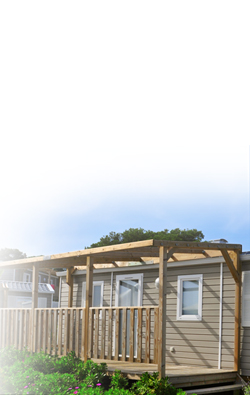


You don’t always hear it said outright, but it’s been passed around the manufactured-home community for years: “You’re not supposed to attach things to a mobile home.” It gets repeated often enough that even simple upgrades start to feel questionable.
That’s why permit questions come up so often. What counts as a mobile home add-on or “addition”? What needs a permit and inspections, and what typically doesn’t?
You can see it play out online all the time. Pizzastork’s Reddit post about adding a window awning is a good example—because it feels like a sensible, low-impact improvement. Then that old warning pops up, and the questions get real: Does a small awning count? Is permitting only for big add-ons, or does it include something like this?
How Permit Decisions Are Made for Mobile Home Add-Ons
Permits and inspections are related, but they are not the same thing. A permit is the approval to do the work. An inspection is the verification that the work was built safely and matches what was approved. Most homeowners experience these through the local authority—typically a city building department if the home is inside city limits, or the county if it is not (with a few local exceptions).
Where Approvals Usually Come From
Behind that, there are usually a few overlapping layers that all matter:
- Building permits and inspections: structural support, footing depth, guardrails and handrails, electrical safety, and how the work is anchored and connected.
- Planning and zoning standards: setbacks, projections, lot coverage, spacing between homes, and height limits.
- Community or park requirements: written approvals, appearance standards, and placement rules inside a manufactured-home community.
A project can clear one layer and still run into another. You might not need a building permit for a small exterior upgrade, for example, but placement could still be limited by setbacks or community rules.
What Local Offices Actually Look At
The important point is that the local office is not deciding based on what you call the project. They classify it based on what the add-on changes. In general, a mobile home add-on draws review when it affects:
- Structure (how it is supported, braced, and anchored)
- Life safety (stairs, landings, guardrails/handrails, access, and egress)
- Systems (electrical, mechanical, plumbing)
- Site compliance (setbacks, projections, lot coverage, easements, spacing)
That framework applies to manufactured homes, too. The home may be factory-built, but the moment you add something on-site—whether that’s an entry structure, a small platform, or a covered area—the local authority is usually the one responsible for approving and inspecting that work.
When Mobile Home Add-Ons Are Permit-Exempt
“Permit-exempt” usually means the building office does not require a building permit for that specific scope. It does not mean the project is exempt from placement requirements, electrical review, or community approvals. It simply means the work fits inside a local exemption category for construction.
Across many jurisdictions, mobile home add-on are more likely to be permit-exempt when it stays in the “accessory-scale” lane:
- Small and non-structural (it does not create a new load-bearing system)
- Built without posts or footings
- Free of any electrical components (wiring, motors, lighting, outlets)
- Low to the ground with no fall-risk conditions
- Does not alter access or egress clearances
In other words, the project looks more like a small accessory than a structure of its own. Building departments write exemption lists with that kind of work in mind—lightweight, wall-supported, and simple enough that it does not carry roof loads or support people walking on it.
That still leaves other rules in place. Even permit-exempt items can be limited by how far they project toward a property line, how close they are to another home, or what your manufactured-home community allows on your site. It is common for a project to be exempt from a building permit but still need community approval or a quick zoning check.
A small, wall-supported accessory—like a compact exterior shade or trim feature—often sits in this category when it meets local size and support limits. Once it grows in depth, needs posts to the ground, or begins to act like a roof, it is usually evaluated differently.
When a Mobile Home Add-On Usually Requires a Permit
Most “permit required” decisions come down to a small set of triggers. If one applies, it is wise to assume review is likely until the local office confirms otherwise.
Posts, Footings, and Foundations
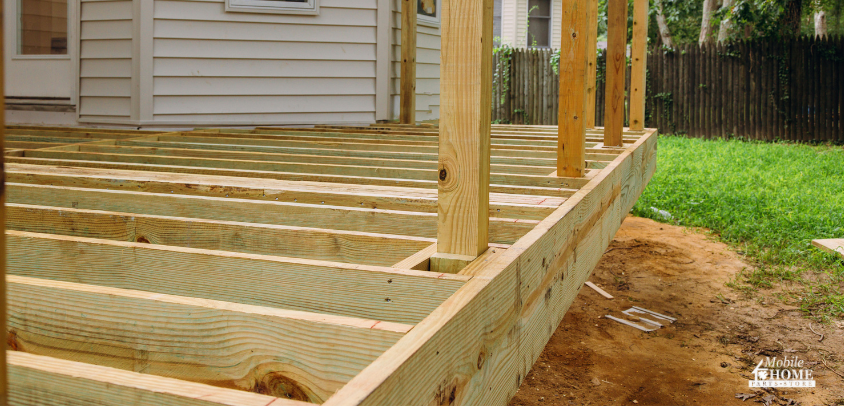
The moment a mobile home add-on needs posts or footings, the project stops being a simple accessory. Now the building office is responsible for questions like footing depth, soil bearing, frost considerations, uplift resistance, and bracing. This is why decks, larger covers, and many entry structures commonly require permits and inspections.
Stairs, Landings, and Fall Safety
Fiberglass stairs, landings, decks, and platforms are almost always treated seriously because people rely on them every day. Review tends to focus on practical safety items: consistent step geometry, stable landings, proper guardrail height where required, and secure handrails. Even a small landing can trigger a review if it is elevated enough to create a fall hazard.
Porch Roofs, Patio Covers, and Wind Loads
A porch roof, patio cover, carport, or larger canopy behaves like a roof in the eyes of the building office. Wind uplift and lateral loads do not care whether the cover looks “light.” If it has a roof-like surface area, it has roof-like forces. Many jurisdictions treat these as permitted construction because failures can be dangerous and expensive.
Electrical Work: Power, Lighting, and Wiring Changes
Anything that introduces power—whether that’s wiring, switches, outlets, lighting, or a powered accessory—usually moves the project into electrical permitting and inspection. Even a small exterior upgrade can shift categories once electricity is involved. Local offices want to confirm that circuits are sized correctly, protected properly, and installed in a way that keeps moisture out. If your mobile home add-on includes lighting, a powered feature, or any new electrical connection, expect review to be part of the process.
Lot Lines, Setbacks, and Site Limits
Even when the structure feels small, placement can trigger approval requirements. Setbacks, easements, and lot coverage limits are common “surprise” factors—especially where lots are tight, or spacing is close. In some communities, even a small projection that crosses a setback line or crowding between homes can be enough to require a review, even if the structure itself might otherwise be exempt.
A Practical Note for Manufactured Homes
Many jurisdictions treat decks, porch roofs, stairs/landings, and other structural add-ons as permitted construction—especially when they are elevated, roof-bearing, post-supported, or tied in a way that transfers loads. For manufactured homes, that local approach is common because any improvements built on-site after installation are typically reviewed locally.
There is another layer to it: manufactured homes are engineered systems. The walls, roof, and frame are designed to handle known loads from the factory, plus certain on-site conditions. When an add-on starts transferring roof loads or wind forces into the home’s structure, building officials often want to see that those loads are either:
- Carried by self-supporting construction (posts and footings that stand on their own), or
- Attached in a way that has been evaluated by an engineer or follows manufacturer guidance.
That is why a small, wall-supported accessory might be treated lightly, while a larger porch cover tied into the roof line is treated much more like a conventional structure.
How Manufactured Home Rules Affect Add-On Permits
Manufactured homes are built under federal construction standards in the factory. That matters for how the home itself is constructed. It does not remove local responsibility for what happens on the site afterward.
Most changes you might be considering—new entry structures, steps, small platforms, or covered outdoor areas—are treated as on-site construction. That is why the permitting answer is often local, and why it can vary from one county to the next. Two homeowners can do the same project with different requirements simply because the local authorities adopted different code editions, applied different exemption thresholds, or enforced placement standards differently.
What Local Officials Evaluate Beyond Permit Rules
This is also why it helps to describe your project by facts (support method, size, electrical, placement) instead of by labels like “small add-on” or “just steps.” Labels create ambiguity. Project facts get clear answers.
For manufactured homes in particular, local offices and communities may also look at:
- How close your home is to the next one,
- Is it a new cover or deck affects fire separation or access?
- Are the home’s wall is being asked to carry loads it was not designed for?
Because of that, many experienced installers lean toward self-supporting add-ons for anything more than a small accessory. The structure stands on its own, and the home’s exterior can be treated more like a weather surface than a primary support.
Quick Classifications: Where Common Mobile Home Add-Ons Usually Land
This is not a substitute for local confirmation, but it will help you predict how projects are commonly classified.
Entry Covers and Canopies
These are often permit-required because they cover a walking path and tend to be larger, more wind-exposed, and frequently post-supported. Even when they attach to the wall, many are treated as structural covers because of roof-like load behavior.
In many jurisdictions, these are reviewed as porch roofs or covered entries rather than as small accessories. That shapes the footing, bracing, and anchoring requirements.
Decks, Landings, and Stairs
Very often, permits are required because the safety expectations are clear and consistent: stable support, reliable fastening, correct geometry, and required guards/handrails. If the platform is elevated enough that a fall would be meaningful, review is common.
On manufactured homes, these are some of the most frequently inspected add-ons, simply because they see daily use and wear.
Porch Roofs, Patio Covers, and Carports
Almost always permit-required because they are roof structures. The building office is responsible for wind/snow loads, anchoring, bracing, and safe clearances.
In higher-wind or heavy-snow areas, you may also be asked for engineering details or span tables. That applies whether the structure is attached to the home or freestanding beside it.
If your project does not fit neatly into a category, the support method is usually the deciding factor. Wall-supported accessory-scale items tend to have the best chance of fitting into exemptions. Anything post-supported tends to be treated as permitted construction.
A 60-Second Permit Pre-Check for Your Mobile Home Add-On
Before you buy materials or schedule an installer, gather five facts. These are the details that typically determine the permit answer quickly.
- What is it?
(window awning, entry canopy, steps/landing, deck, roofed cover) - How is it supported?
(wall-supported only, or posts/footings) - How big is it?
(width and projection; height off grade for platforms) - Is it powered?
(motor, lights, outlets) - Where is it on the lot?
(near property lines, easements, or tight spacing)
Questions to Ask Your Local Building Office
With those facts, you can usually predict the outcome with high accuracy. If you do need to ask the local office, those same details get you a direct answer instead of a slow back-and-forth.
When you call or email, a few focused questions can make it even smoother:
- “Is this installation permit-exempt here? If yes, what limits apply to projection and support?”
- “How are setbacks measured for projections like entry covers, stairs, and landings?”
- “If posts or footings are involved, what footing depth or inspections apply?”
- “If it’s motorized or includes lighting, is an electrical permit required?”
Those questions match how projects are evaluated and help you get a clear answer the first time.
Permits First, Then the Build
If you’re planning a mobile home add-on, the best thing you can do early is get clear on permits and inspections. It keeps the project from stalling later, and it helps you plan the scope with a lot more confidence.
If you want more ideas and a bigger-picture look at what’s possible, read The Ultimate Guide to Mobile Home Additions. It’s a solid next step while you’re still deciding what to build and how to approach it.
And when you’re ready to start pulling parts and supplies together, the Mobile Home Parts Store team is here to help you get what you need to complete your new addition.
Tags: awnings and canopies, HUD, mobile home add-ons, mobile home addition, mobile home deck, permits

