 SIGN-UP FOR THE MHPS NEWSLETTER!









Replacing mobile home windows is one of those projects that instantly makes a difference—you’ll feel it in your comfort, notice it in your energy bills, and see it every time you pull into the driveway. But here’s the catch: even the highest-quality window won’t work as it should if the size isn’t right. That’s why accurate measurements matter so much.
Measuring doesn’t have to be complicated or time-consuming. In this guide, we’ll walk through four quick, repeatable steps that work for most single- and double-wide homes. You’ll also pick up a few terms, learn which tools you need, and get a pro tip or two along the way. By the time you’re done, you’ll have a tidy measurement sheet you can hand to any supplier or installer with confidence.
Pro Tip: Measure every single opening—even if two windows look identical. In mobile homes, settling and frame shifts can throw off sizes by fractions of an inch.
Before You Measure: Know Your Window Type & Tools
Before we grab the tape measure, let’s make sure you know what you’re working with.
Identify Your Window Type
Your measurement method depends on the type of window you have:
- Flange-mount (nail-fin/utility flange): These are very common on mobile home windows. They attach from the outside, with a flange overlapping the siding. For measuring, you’ll ignore the flange and focus only on the outer frame size.
- Insert/replacement (no exterior flange): These fit inside the existing frame. Measurements are taken from inside, going jamb-to-jamb.
Knowing your type will save you from measuring decorative trim or siding instead of the actual frame.
Learn the Parts of the Window
You don’t need to memorize a full glossary, but knowing these parts will make instructions clearer:
- Head: The top horizontal part of the frame
- Jambs : The vertical sides of the frame
- Sill: The bottom horizontal part of the frame
- Stops: Interior or exterior strips that hold the sash in place
- Flange: The outer lip that overlaps the siding on flange-mount mobile home windows
Gather Your Tools
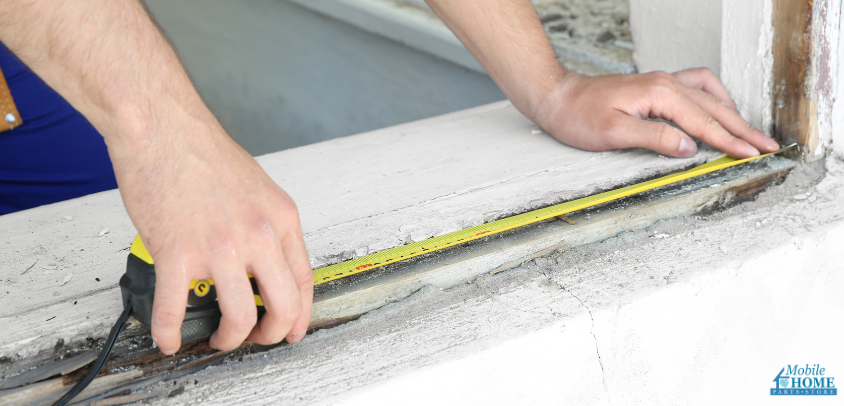
- 25-foot tape measure
- Notepad and pencil (or a phone/tablet if you prefer digital)
- Level (to check if things are square)
- Small ruler or combination square for depth measurements
When recording, always write your numbers as Width × Height (W × H) and take three measurements for each dimension—top, middle, and bottom for width; left, center, and right for height. Always use the smallest of the three.
Good to know: While mobile homes often have “common” window sizes like 30×60 or 36×54, those are just guidelines. Always measure—your actual opening size is the only one that matters.
Step 1 : Measure the Width
How you measure depends on your mobile home window type:
For Flange-Mount Mobile Home Windows (Outside Measurement)
- Place your tape measure on the outer frame edge (exclude the flange) and measure from the left side to the right.
- Take three measurements—one across the top, one across the middle, and one across the bottom.
- Use the smallest of the three. This ensures the new window will fit even if the frame isn’t perfectly parallel.
For Insert-Style Windows (Inside Measurement)
- Open the window sash if necessary.
- Measure jamb-to-jamb (inside edge of the vertical frame members) at the top, middle, and bottom.
- Again, use the smallest number for your width.
Why this matters: In older mobile homes, frames can shift slightly. Measuring in three spots accounts for any subtle warping.
Step 2 : Measure the Height
Just like width, height measurements depend on your window style:
Flange-Mount
- From the outside, measure from the top edge of the outer frame (excluding flange) to the bottom edge.
- Take measurements at the left side, center, and right side of the frame.
- Record the smallest.
Insert-Style
- From the inside, measure from the highest point of the sill (the flat area the window rests on) to the underside of the head jamb.
- Take measurements on the left, center, and right, and use the smallest.
Pro tip: If the sill is sloped, place a small straightedge across the highest point before measuring—this avoids losing a fraction of an inch to an angle.
Step 3 : Confirm the Depth (When It Matters)
Depth is especially important for insert-style replacements because the new frame needs to fit within the existing opening without interfering with blinds, interior trim, or stops.
- Measure from the inside stop to the outside stop of the frame.
- Take a couple of readings in different spots and use the smallest.
- Most replacement mobile home windows need about 3-1/4 inches of depth. If your opening is shallower, you might need a different style or extensions.
For flange-mount mobile home windows, depth is usually less of a concern but still worth checking—especially if you’re adding interior trim.
Step 4: Check for Square, Level, and Plumb
Even the most precise measurements can be thrown off if the opening isn’t square.
- Diagonal Check: Measure from the top-left corner to the bottom-right corner, then top-right to bottom-left. If the numbers differ by more than 1/4 inch, your opening is out of square.
- Level and Plumb Check: Place a level on the sill (horizontal) and against each jamb (vertical). Note any tilts.
- If your window is slightly out of square, order the smallest measurements you took and adjust with shims during installation. If it’s significantly off, you may need minor framing adjustments.
Opening Up to What’s Next
You’ve done the hard part—grabbed the tape measure, taken your time, and got the numbers you need. That’s all it takes to set the stage for a smooth window upgrade. Now, it’s just about choosing the right fit for your home.
At the Mobile Home Parts Store, we’re here when you’re ready to make that call. Our selection of Kinro Low-E windows helps keep the heat out in summer and the warmth in the coming winter, while Kinro Vinyl windows deliver a clean, low-maintenance look that lasts. And if you hit a snag or just want to double-check something before you order, you’ve got a team ready to walk you through it—no guesswork, no stress.
Your measurements are more than numbers on a page—they’re the first step toward a home that feels brighter, more comfortable, and more yours. We’ll be here with the parts, the supplies, and the know-how to help you make it happen.
Tags: how to, Kinro windows, mobile home replacement windows, mobile home windows

