 SIGN-UP FOR THE MHPS NEWSLETTER!








Quick Overview
A mobile home exhaust fan needs to move enough air for the room’s size, measured in CFM, cubic feet per minute. Bathrooms typically need 50 to 110 CFM depending on square footage, while kitchen range hoods run higher. Ventline is the most common OEM brand for manufactured housing ceiling assemblies. Matching CFM to room size and sealing the roof cap properly are the two details that determine whether the fan actually solves a moisture problem.
Steamy mirrors that will not clear, a musty smell that lingers after every shower, or a kitchen that stays hazy after cooking are all signs that a mobile home exhaust fan is not doing its job, or was never sized right to begin with. Moving humid air out fast enough matters more in a manufactured home than in a site-built house, since smaller rooms and tighter construction give moisture fewer places to go before it settles into drywall and cabinetry.
Choosing the right mobile home exhaust fan comes down to two things: getting the CFM rating correct for the room, and installing it so the roof cap actually sheds water instead of inviting it in. This guide covers both.
Understanding CFM Ratings for a Mobile Home Exhaust Fan
CFM stands for cubic feet per minute, the amount of air the fan moves. A fan with too low a CFM rating runs constantly without ever really clearing the room. One rated too high for a small bathroom can be noisy and pull conditioned air out faster than it needs to.
The standard sizing formula for a bathroom is straightforward: multiply the room’s square footage by 1.1 for an 8-foot ceiling. A 70-square-foot bathroom needs roughly a 77 CFM fan, which rounds up to the next available size, typically 80 or 90 CFM. Most mobile home bathrooms fall in the 50 to 110 CFM range depending on size.
Kitchens work differently. A range hood’s CFM needs are tied to the stove’s BTU output rather than square footage alone, generally 1 CFM per 100 BTU for a gas range. An exhaust fan over an electric range typically needs less airflow than one paired with gas, but ducting length and any bends in the vent run both reduce effective airflow, so it is worth sizing slightly above the bare minimum.
Ceiling Assembly vs. Wall-Mount Options
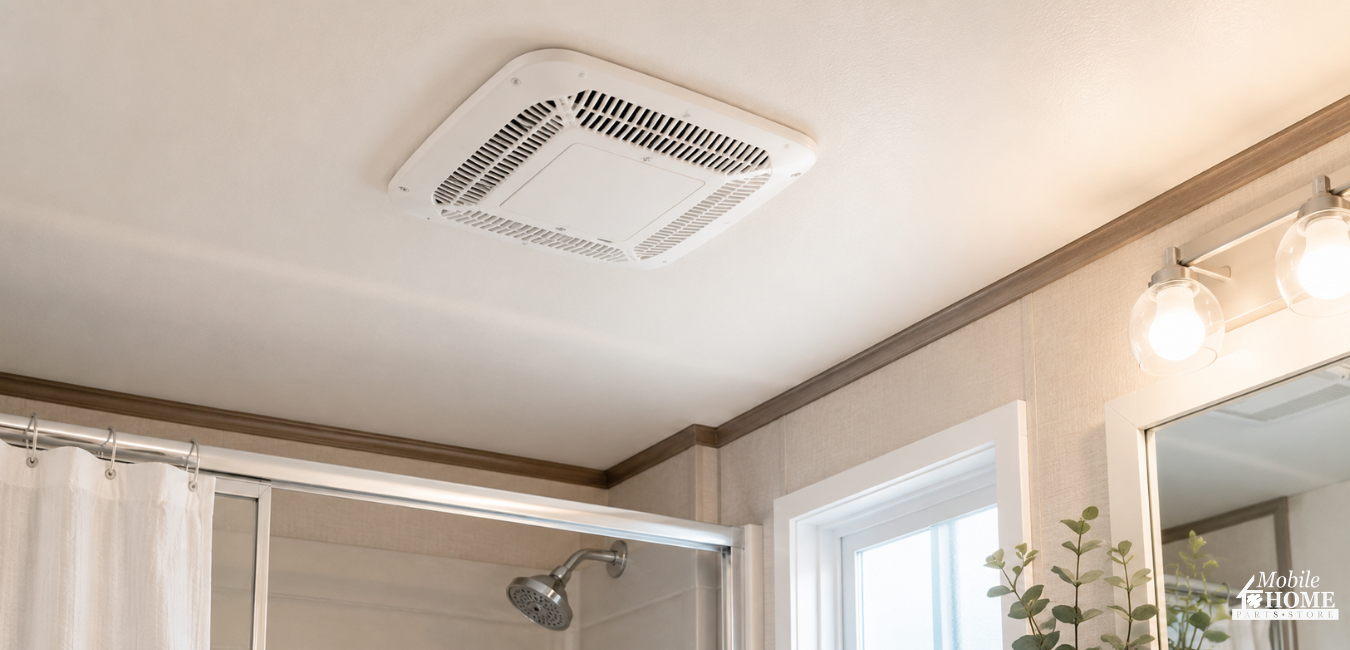
Most manufactured homes use a ceiling-mounted exhaust fan that vents straight up through a roof cap, the setup Ventline built its reputation on. This is the simplest configuration to install and service since there is no ducting run through wall cavities to worry about.
Wall-mounted units are less common in mobile home bathrooms but show up in some kitchen configurations, venting horizontally through the sidewall instead of the roof. They require their own exterior vent cap and a clear path through the wall cavity, which is more involved than a straight ceiling shot.
Installing the Fan
1. Confirm the Roof Opening Size
Ventline and most OEM replacement fans are built to match standard manufactured housing roof openings, but always confirm the housing dimensions against the old unit before ordering. A mismatch here is the most common reason a straightforward swap turns into a bigger repair.
2. Disconnect Power and Remove the Old Fan
Shut off power at the breaker before touching any wiring. Remove the interior grille, disconnect the wiring, and take out the old fan housing from inside the ceiling cavity.
3. Inspect and Reseal the Roof Cap
This is the step most likely to get rushed, and the one most likely to cause a leak later. Check the roof cap and the sealant ring around the base for cracking or gaps before setting the new fan in place. A bead of butyl or lap sealant, whichever matches your roof material, around the base is standard practice on any roof penetration.
4. Wire and Mount the New Fan
Connect the wiring per the fan’s included diagram, mount the housing, and secure the interior grille. Restore power and test the fan before considering the job finished.
5. Test for Proper Airflow
Hold a tissue near the grille with the fan running. It should pull firmly against the vent. Weak airflow after installation usually points to a duct run that is too long, has too many bends, or a roof cap that is partially obstructed.
Maintaining the Fan
Dust and grease buildup on the fan blades and grille reduce airflow over time even on a correctly sized unit. Clean the grille and visible blades every few months, more often in a kitchen exhaust fan exposed to cooking grease. Check the roof cap seal once a year for cracking, since UV exposure breaks down sealant faster on the roof than anywhere else on the home.
A fan that suddenly gets louder or vibrates is often a sign the motor bearing is wearing out or a blade has become unbalanced from debris buildup. At that point, replacement is usually more cost-effective than repair given how affordable most mobile home exhaust fan units are.
Mobile Home Exhaust Fan FAQs
What CFM do I need for a mobile home bathroom exhaust fan?
Multiply the bathroom’s square footage by 1.1 for a standard 8-foot ceiling. A 60-square-foot bathroom needs about 66 CFM, which typically means an 80 CFM fan since that is a common available size.
Are Ventline exhaust fans the standard for manufactured homes?
Ventline is one of the most common OEM brands for mobile home ceiling exhaust fan assemblies, and most replacement units are built to fit the same roof opening dimensions Ventline established as the industry standard.
Can I install a mobile home exhaust fan myself?
Yes, for most ceiling-mounted units this is a manageable weekend project if you are comfortable working with basic electrical connections and accessing the roof safely. Always shut off power at the breaker first.
Why is my mobile home exhaust fan not clearing steam?
Undersized CFM for the room, a clogged or dirty fan grille, a blocked roof cap, or a duct run with too many bends are the most common causes. Check the CFM rating against the room’s square footage first.
How often should a mobile home exhaust fan be replaced?
Most units last 10 to 15 years with regular cleaning. Increased noise, vibration, or a noticeable drop in airflow are signs it is time to replace rather than repair.
Getting the CFM rating right and sealing the roof cap properly are what separate a mobile home exhaust fan that solves a moisture problem from one that just adds noise. Browse Mobile Home Parts Store’s ventilation and exhaust fan selection to find the right fit for your home.

